Circuit Library › Test gear › bridge
Return-Loss Bridge
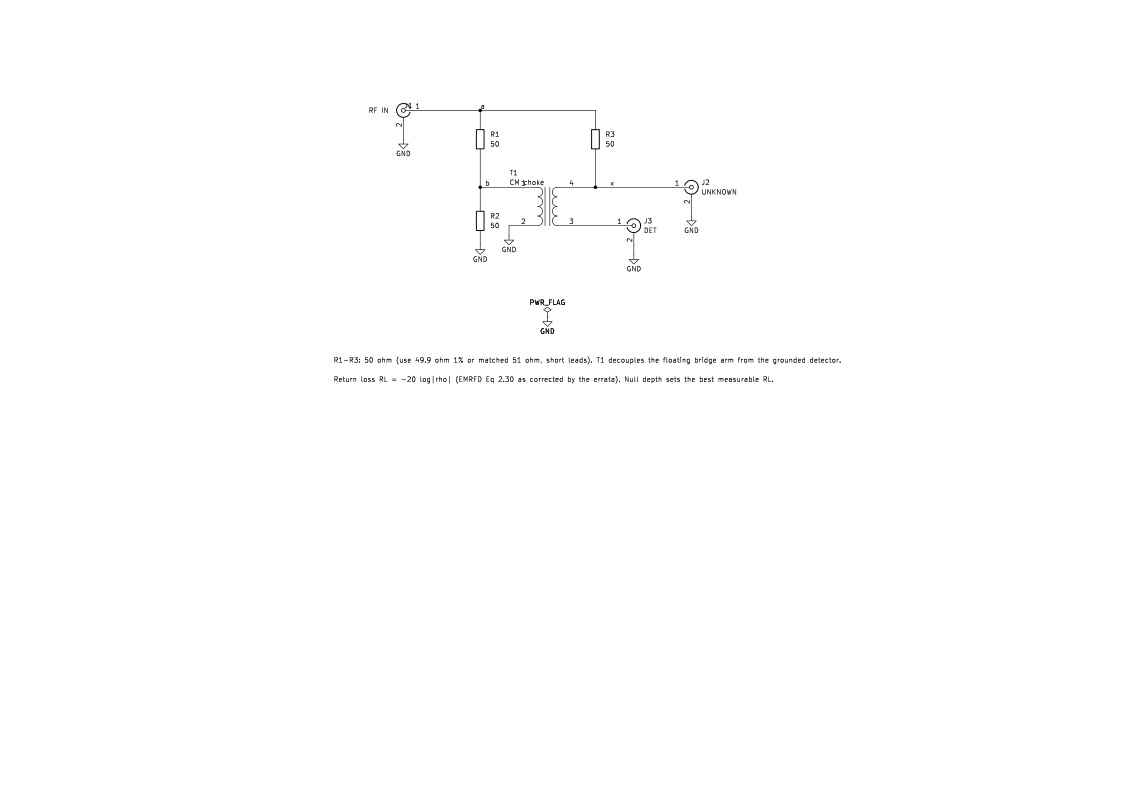
Bench sheet (PDF)Schematic PDFSPICE netlist (.cir)KiCad project (.zip)
- rl_db 9.56 simulated
- null_db 50.5 simulated
What it does
Measures how close a load is to 50 Ω. With a signal generator and a detector, it reads return loss directly in dB.
How it works
A Wheatstone bridge of 50 Ω arms compares the unknown at the X port with a reference. At a perfect match the bridge balances and the detector sees nothing. T1, a bifilar choke, lets the detector be ground-referenced. Return loss is RL = −20 log|ρ| (EMRFD Eq 2.30 as corrected). An open and a short both read 0 dB, which you use as the calibration reference.
Building it
- Use matched, non-inductive resistors. The null depth sets the best RL you can measure (about 50 dB simulated).
- Keep the leads very short and build in a small metal box.
Tuning and testing
Read the detector with the X port open; that's the 0 dB reference. Then connect a 50 Ω load and confirm a deep null.
Where it comes from
The classic return-loss bridge from Experimental Methods in RF Design, Chapter 2.
Simulation
Simulated in ngspice from the schematic netlist. Not a measurement.
Parts list
| Ref | Value | Qty |
|---|---|---|
| J1 | RF IN | 1 |
| J2 | UNKNOWN | 1 |
| J3 | DET | 1 |
| R1-R3 | 50 | 3 |
| T1 | CM choke | 1 |
SPICE netlist
References
- EMRFD Fig 2.44, p. 2.16 (errata: affects-circuit: Eq 2.30 on p. 2.16 should use the magnitude of the reflection coefficient: RL = -20 log|rho|. The circuit itself is unchanged.)